
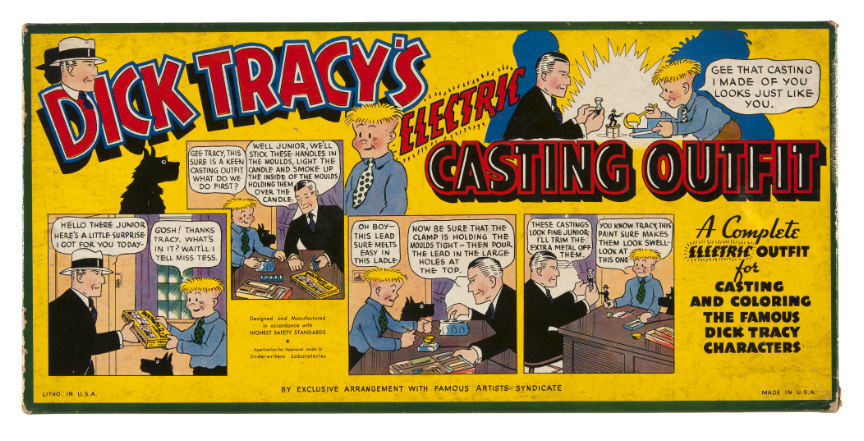
Dick Tracy first appeared on Oct. 4, 1931 — and crime comics were never again the same. Developed by Chester Gould, the first weeks comic strip gives us Dick Tracy's Girlfriend, Tracy's girlfriend, Tess Trueheart kidnapped and her father murdered. Tracy joins the police as a plainclothes detective, tracks down the killers, and rescues Tess. He then decides to stick with the force. His determination, incorruptible honesty, and well-known willingness to use violence in excess of any that had ever before been seen in comics combine to carry him quickly to the top of his profession.
It was Captain Joseph Patterson, the Chicago Tribune Syndicate editor who decisively influenced the direction of such diverse strips as Little Orphan Annie and Gasoline Alley, who named the strip (Gould wanted to call it "Plainclothes Tracy"), as well as Tracy's girlfriend. Although he never contributed so much as a single pen stroke to an actual published strip, Patterson's effect on American comics was profound. It's anybody's guess how much a snappy title contributes to a work's success, but the fact that "Dick Tracy" rolls so easily off the tongue certainly didn't hurt.
Dick tracy's villans were also known for their bizarre deformities. The Blank (1937), Little Face Finney (1941), Pruneface (1943), The Brow (1944), Shakey (1945), Pear Shape (1949) and many more. Generally a Dick tracy Criminal only lasted thru the current comic strip as Tracy was known to be quite liberal with the bullets.
Another thing Tracy has always been famous for is up-to-date technology. In 1964, he traded in his two-way wrist radio, which had been given to him in 1946 by inventor Diet Smith, for a two-way wrist TV.
Dick Tracy was a radio show from 1935-48, and the character was featured in a series of novels and Big Little Books during that time, as well. He made a leap into movies in 1937, when Ralph Byrd portrayed him in a 15-part serial from Republic Pictures. A long series of B-grade feature films followed, some with Byrd and some starring Morgan Conway as Tracy. They came out regularly for the rest of the 1930s and all through the '40s. A highlight was Dick Tracy Meets Gruesome (1947), in which the eponymous bad guy was played by Boris Karloff. Tracy's screen career came to a close with a 1951-52 TV show, starring Byrd.
In 1995, when the U.S. Postal Service issued its "Comic Strip Classics" series of commemorative stamps, Tracy was right up there with The Katzenjammer Kids, Little Nemo in Slumberland, Barney Google, and the rest of that select crowd.
Chester Gould retired in 1977, and died in 1985. The writing of the strip was taken over by Max Allan Collins, a detective novelist and long-time fan of Gould's work, whose other comics credits include Ms. Tree; and the art by Gould's assistant, Rick Fletcher. Fletcher died in 1983 and the strip was passed on to Pulitzer-winning editorial cartoonist Dick Locher, who, teamed with writer Michael Kilian, draws it today.
The secret of Tracy's success? Not a great love of civil liberties, to be sure! No, Tracy has always been a tough cop — but an absolutely honest one, and compassionate toward the innocent and helpless. That's the combo that made him popular, and has kept him that way for eight decades. It is with this background that during the 1930's Allied Mfg. Company developed a series of metal moulds with a Dick Tracy theme. With at least three sets of plates, one was called "Dick tracy" and allowed the moulding of Dick tracy, Chief Brandon and Junior. A second mould, number 91, included Boris Arson, Pat Patton and Tess Trueheart. There is another mould that is known called Tracy Fighting and has the number 51. I am however unclear on who the three men on the mould are.
Comments