 We know that it is a Rapaport mould that was also sold by REB (but that is a different story...) Not by Home Foundry. It is identified in the Rapaport catalogs as a WWII "Attack Bomber", whereas the Home Foundry Bomber mould is called "Stunting" and while it appears to also be a bomber there are a couple of subtle differences between the two moulds. First the wheels are separate in the Attack Bomber. The Stunting Plane also has a three blade prop while the Attack Bomber has a two blade prop. Finally the Stunting Plane is listed in catalogs as early as the 1930's which would place it prior to WWII.
So what kind of Bomber is our WWII Attack Bomber? Well there were generally 2 classes of Bombers during WWII, the Heavy Bomber and the medium Bomber. The B-25 Mitchell and the B-26 Marauder were both twin engine Medium Bombers, while the B-17 Flying fortress and B-24 liberator had 4 engines. So, the engine count would eliminate the B-17 and the B-24 from our list of suggestions of our mould. There is however an issue with both the B-25 and the B-26 in that they had propellers with 3 blades while our mould only creates pops with 2 blades. Is this just a mould issue since it would be more difficult to pour a three blade than a two blade. I don't think so since the Stunting plane from Home foundry pours a three blade propeller.
If we have now eliminated both of the heavy bombers due to their engine count and both the the medium bombers due to their propeller blade count, what do we have left? During WW2 (and still today, mostly) there were different designators or "letters" used to identify plane classes: A for attack. B for Bombardment, C for Cargo, L for Liaison, P for Pursuit and T for Training. This letter indicated the function of the plane. The following number indicated sequence within a type as in P-51. If there was a letter after the number it indicated an improved model type such as B-17E. So, there is another classification that could possibly be considered a bomber, the "A" or attack plane. During World War II the primary mission of attack aircraft was to support ground forces in battle and aircraft were designed with this in mind. The attack aircraft provided support and operated primarily at low altitudes.
The attack planes were known for their high speed, maneuverability and weapons. They carried both machine guns and bombs. The A-20, A-24 and A-26 were the attack aircraft most used by the Army Air forces (AAF) during the war. Critically for our discussion they were also considered "light bombers". Since the title of the mould is "Attack Bomber" it would seem to make sense that the mould would be one of these.
The A-20 Havoc
The A-20 Havoc, manufactured by Douglas as a light bomber, went into production in 1939 and by the end of production in September of 1944 over 7,000 had been manufactured. The A-20 is a good candidate for our mould for several reasons. First it is a twin engine, the wings appear to sweep forward as they do in our mould. there is a "hump" (apologies to those of you who are military experts) that runs along the top of the fuseloge from in front of the engines to just past the back of the wings which matches our mould. However... The A-20 NEVER had 2 bladed propellers, and it had a wheel in the nose while our mould appears to create a "tail Dragger" or a plane that has a smaller wheel at the base of the tail of the plane. in fact, none of the Attack Bombers were taildraggers. As such while the mould title is Attack Bomber, There are no Class "A" planes that fit this description.
Douglas XB-18
So does anything "real" match our model? Yes, sort of. There was an early version of the Douglas B-18 Bomber (yes we are back to the "B's") that was a twin engine. Based on the Douglas DC-2 civilian aircraft, the contract to build the B-18 was awarded to Douglas on January 1936. Early prototypes were identified as XB-18 and did indeed have 2 bladed props. Additionally, the landing gear of the B-18 closly match the mould, and the B-18 was a tail dragger. The cockpit also is very similar to the mould, although the gunner just forward of the tail found in production planes is missing is missing on the mould (though to be fair there is a feature in that position, a rectangle with a line across the middle of it). As for the wings, the outlines of the wing flaps on the mould also match the B-18. Finally, the nose of the early versions of the B-18 is a much closer match to the mould than the A-20.
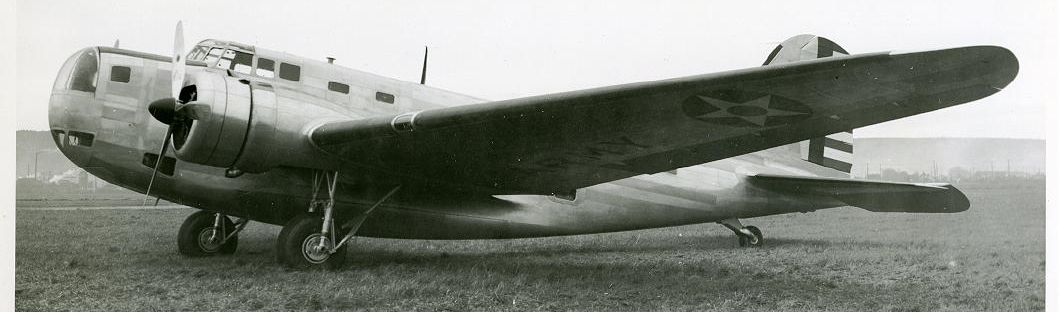
The XB-18 was an early prototype and as development continued the engines became more powerful necessitating three bladed props. Other changes including the gunner and an evolution of the nose occured throughout the production of these bombers.
So if I had to guess, without additional info from Rapaport, I would have to say that our plane mould is that of a B-18. The identifier on the wing NZ-4107-B is fictional as far as I can determine. New Zealand never bought any B-18's, and the serial number 4107 does not match any New Zealand military aircraft. finally, New zealand never used the B suffix on any of their planes. All of this also ignores that the other wing says "U S Army" on it!
I have seen some folks saying the mould was of a map plane. I have no clue where this idea came from and have not been able to corroborate this concept with any of the airplane military folk.
If you know something I either got wrong or have additional information on the mould, let me know in the comments section!
Comments