
S. Sachs/Metal Cast Products Co. 1920- ~1948
S. Sachs Toy Soldier Manufacturing Co., 32 Union Square, New York 1920 -1925
H. Sachs Metal Casts Products Co. 1696 Boston Rd., New York 1925 - 1950's
The Early Foundation & H. Sachs (1920s)
The Partnership: While Samuel Sachs provided the technical foundation and early patents for the casting systems, Henry (H.) Sachs was clearly the commercial leader. By 1925, he was already branding the "Metal Cast"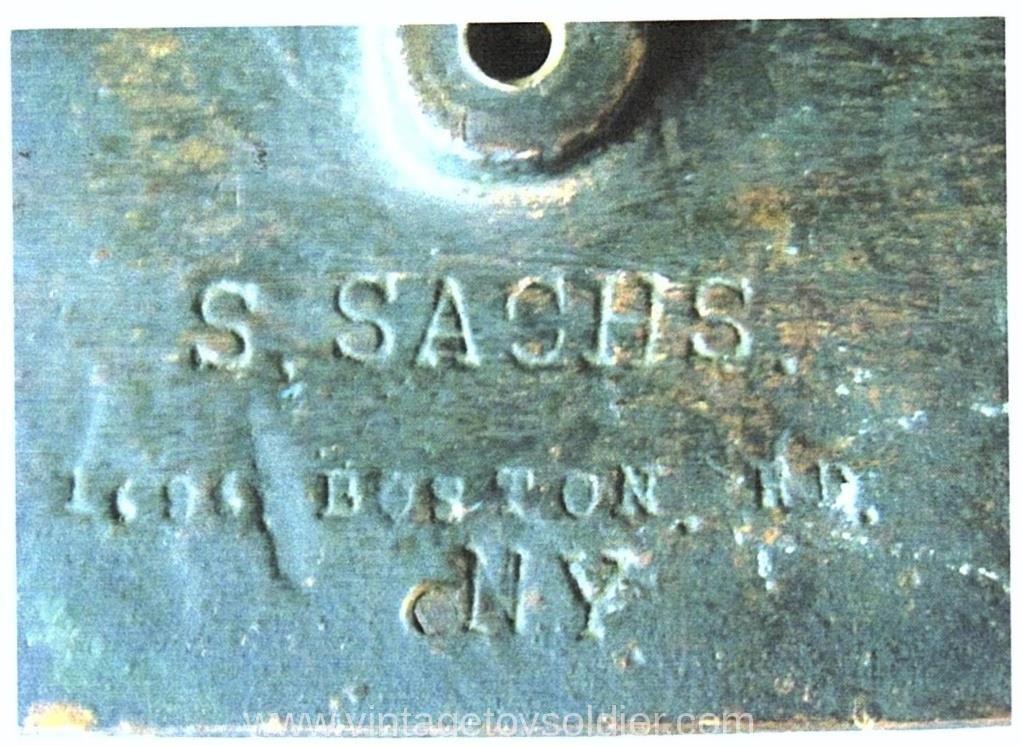 name and distributing catalogs. I believe that as the company pivoted to the Metal Cast name, they also dropped S. Sachs Boston NY from their solid cast moulds. I have the Charlie Chaplin mould that was available from 1920 and last seen in the 1928 bulk price list. The mould is a heavy duty bronze castingform with hole and pins for registration. the backs have threaded boss but curiously no identification on it. Perhaps is was a later production piece after they became Metal Cast?
The earliest molds focused on WWI-style "Doughboys" and simple civilian figures. The 1930s marked the "Golden Age" for Metal Cast. As the Great Depression hit, the Sachs family pivoted their marketing to focus on economic survival. Rather than selling toys, they sold the means of production. They marketed to men looking for extra income, suggesting they buy molds to cast figures and sell them to local dimestores. During the 1930's, the catalog expanded to hundreds of designs, covering everything from Wild West scenes a nd Circus performers to Religious statuary and Farm animals. The catalogs from the 1920's and 1930's identify both aluminum and bronze moulds or "Castingforms". However by 1934 their catalogs focused almost exclusively on what Metal Cast referred to as "Full Body Hollow Toy Soldiers" which were hollow castings. Gone from the catalog were the solid castings such as Charlie Chaplin, although many of the original solid form castings look like they became available as hollow form.
By the late 1930s, the market was shifting. Retailers wanted finished, painted products rather than just molds for hobbyists. In 1938 the Sachs family established Bergen Toy & Novelty Co. (Beton). This allowed them to mass-produce finished metal toys at the Boston Road plant and sell them under a distinct brand name. When WWII began in 1941, the government restricted lead and tin. While Metal Cast continued to sell existing mold inventory, the production of new metal molds for the public was largely suspended as materials were diverted to the war effort.
After the war, the toy industry underwent a radical transformation that eventually led to the end of the metal mold era. By 1946, under Henry Sachs' leadership, Beton began a heavy transition into plastic injection molding. Plastics were lighter, cheaper to ship, and didn't require the dangerous heat of molten metal. While Metal Cast continued to run occasional ads for their iron molds into the mid-1950s, the "hobby" was dying. The rise of ready-made plastic playsets and growing public awareness of lead safety made home casting less attractive for families. By the late 1950s, Metal Cast Products Co. ceased active operations. The 1696 Boston Road location, once a hub of "making your own toys," eventually passed into history.
Additional detail on Metal Cast to Beton can be found here
Revised 17 Sep 2026
Comments